
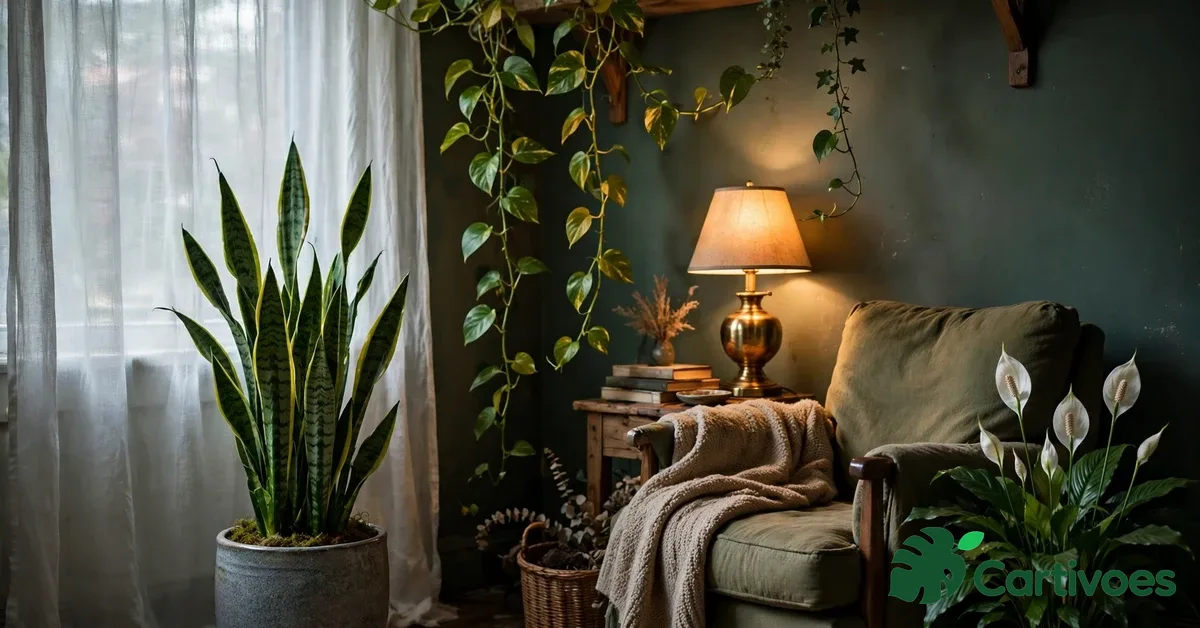
Low Light Houseplants: 17 Shade-Lovers for Dim Rooms
Your bedroom faces an alley. Your bathroom has frosted glass. And that corner by the bookshelf gets about as much light as a cave. Sound familiar? You’ve probably been told you just can’t have plants — or worse, you’ve watched a sun-loving fiddle-leaf fig slowly give up in a dark room and decided you have a black thumb.
Here’s the truth: you don’t have a plant problem. You have a plant-selection problem. Some species evolved under dense rainforest canopies where direct sun is a rumor, not a reality. They’re not settling for your dim room — they’re built for it. Cast iron plants survived Victorian parlors lit by gas lamps.
Snake plants hold their own in office corners lit by nothing but fluorescents. ZZ plants go weeks without water and barely notice.
This guide is a system, not a shopping list. We’ll diagnose your actual light level first (with a two-second test you can do right now), then pick from 17 plants tiered by exactly how dim they can go, place them room by room, and adjust your watering and feeding to the slower rhythm of a shady home.
And because most of the toughest low-light champions are quietly toxic to pets, there’s a safety check nobody else bothers to write. Ready to green up the gloom?
Quick Answer
The best low light houseplants are shade-adapted species that evolved under rainforest canopies: snake plant, ZZ plant, cast iron plant, pothos, heartleaf philodendron, Chinese evergreen, peace lily and parlor palm. Three rules matter: match the plant to the light you actually have, water only when the soil dries, and move a struggling plant closer to the window first.
What ‘Low Light’ Actually Means (Take the Shadow Test)
Most plant deaths in dim rooms start with a misunderstanding, not neglect. “Low light” feels vague — is your bedroom low light? Your hallway? Your bathroom with the frosted window?
Here’s a test you can do right now: hold your hand about a foot above a white sheet of paper in the spot where you want a plant, at midday. If your hand casts a sharp, defined shadow, that’s medium-to-bright indirect light. A soft, fuzzy shadow? That’s low light — prime territory for this guide.
And if you can barely see any shadow at all, that’s very low light: your options narrow to the toughest plants on Tier 1, and you should honestly consider a grow light.
Plant scientists measure light in foot-candles, and while nobody expects you to buy a meter, the numbers explain a lot. Horticulturists commonly use about 100 foot-candles as the baseline for low light; a north-facing window or a spot several feet from a bright window typically sits in that neighborhood. For perspective, a sunny south-facing windowsill can hit 2,000+.
Indoor light drops off shockingly fast — a plant five feet from a window gets a fraction of the light of one sitting on the sill. Every foot matters.
Two more things about light that the plant tags never explain. First, duration beats intensity. A plant in steady, modest light all day will outperform one that gets two hours of weak morning sun and then sits in darkness.
Second, consistency matters: north-facing windows are actually lovely for low-light plants because the light, while dim, is even and gentle all day — no harsh afternoon blast to scorch leaves. And here’s a free tool most people ignore: your phone.
Free lux-meter apps won’t win lab awards, but they absolutely tell you whether your hallway is 100 lux or 800, which is the difference between “this plant will thrive” and “this plant will merely survive.”
Low Light ≠ No Light: The One Truth Nobody Tells You
Let’s get this out of the way, because no honest article skips it: no houseplant lives in total darkness. Plants photosynthesize. They need light the way you need food — less than you might think, but never zero. A windowless bathroom, a closet, a hallway with no windows at all: those are not plant spots, they’re plant graves.
Even the cast iron plant, the toughest thing on this list, will slowly starve in a room it can’t see across.
Does that mean your windowless bathroom is hopeless? Not at all — it means the answer is a grow light, not a tougher plant. A simple full-spectrum LED bulb (more on those below) turns any dark corner into viable plant real estate. The mistake is expecting a low-light plant to do a grow light’s job.
Once you accept that, everything else in this guide gets easier: you’re matching plants to real, measurable light instead of hoping for botanical miracles.
There’s a flip side worth knowing, too. Many plants sold as “low light” would actually grow faster in brighter light — they just tolerate dimness better than most. “Tolerates low light” means the plant stays healthy and attractive in shade, not that it secretly prefers darkness.
Give your pothos a brighter spot and it’ll reward you with bigger leaves and faster vines. The low-light label is a floor, not a ceiling.
The 17 Best Low Light Houseplants, Ranked by Tolerance
Every other list on the internet dumps a dozen plants in one bucket and calls it a guide. But “low light” isn’t one thing — there’s a real spectrum, and picking from the right tier is the difference between a plant that thrives and one that just… persists.
So here are 17 proven low light houseplants, sorted by how little light they can genuinely handle:
| Tier | Plants | Light floor |
|---|---|---|
| Tier 1 — Deep-shade survivors | Cast iron plant, ZZ plant, snake plant, heartleaf philodendron, darker-green Chinese evergreen | Fuzzy-shadow corners, north windows, several feet from any window |
| Tier 2 — Trailers & hangers | Golden pothos, jade pothos, satin pothos (Scindapsus), spider plant, heartleaf philodendron | Low-to-medium indirect light; tolerate dim shelves |
| Tier 3 — Statement plants | Corn plant (dracaena), dragon tree (dracaena), parlor palm, kentia palm, dieffenbachia, peace lily, lucky bamboo | Bright-enough low light; some can flower (peace lily) |
A note on variegation before we dive in: the darker the leaf, the better it handles shade. Variegated leaves carry less green chlorophyll, so a highly variegated cultivar needs more light than its plain-green sibling. In a truly dim room, reach for the solid-green forms — jade pothos over marble queen, plain heartleaf philodendron over the ‘Brasil’ cultivar.
This is one of those rules Penn State Extension horticulturists repeat constantly, and it’s worth tattooing on your memory.
Tier 1: The Deep-Shade Survivors
These are the plants you buy when your room fails the shadow test with flying colors — the ones that keep their dignity in corners where other plants go leggy and sad. If you only remember five names from this article, make it these five.
Cast Iron Plant (Aspidistra elatior)
The name is the review. This plant survived Victorian parlors — coal dust, gas lamps, drafts, and neglect — so your dim living room is, by historical standards, a luxury resort. Its broad, dark-green leaves are practically engineered for shade: maximum chlorophyll, minimum fuss.
It grows slowly (a blessing in a small space), tolerates temperature swings, and handles dry soil far better than wet. Water every 1–2 weeks, letting the soil dry between. Bonus: it’s non-toxic to cats and dogs, a rare gift in this tier.
ZZ Plant (Zamioculcas zamiifolia)
The ZZ plant looks like it was designed by someone who got tired of plants dying. Thick, waxy, almost plastic-looking leaflets that shrug off dust and drought; underground rhizomes that store water like a camel stores fat. It can go a month without watering and still look glossy.
In low light it grows slowly — sometimes comically slowly — but it grows. Water once every 3–4 weeks, and let it dry fully between. One warning: all parts are toxic to pets if chewed, so keep it off the floor if you have a curious cat.
Snake Plant (Dracaena trifasciata)
You’ve seen snake plants in dentist offices and dim restaurant corners for a reason: they’re nearly indestructible. The upright, sword-like leaves store water, tolerate irregular care, and hold their shape for years in low light. Growth will be slow and new leaves smaller than in bright light — that’s normal, not failure.
Water every 2–3 weeks, letting the soil dry completely. The only thing that kills a snake plant is kindness in liquid form: overwatering. Also mildly toxic to pets, so mind the placement.
Heartleaf Philodendron (Philodendron hederaceum)
If the ZZ plant is a camel, the heartleaf philodendron is a Labrador — friendly, forgiving, and happy almost anywhere. It trails beautifully from shelves, tolerates low humidity better than most tropicals, and bounces back from missed waterings. Pinch back the vines occasionally and it’ll branch out instead of going stringy.
Water when the top inch of soil dries. Note: like its pothos cousin, it’s toxic to pets if eaten.
Chinese Evergreen, Dark Cultivars (Aglaonema)
Chinese evergreens are the chameleons of dim rooms — big, lush leaves in greens, silvers, and (in brighter spots) pinks and reds. Here’s the key: in truly low light, choose the darker green cultivars. The flashy variegated ones need more light to keep their color; the deep-green forms settle happily into shade.
They tolerate inconsistent watering and stay full and handsome for years. Water weekly, letting the top inch dry. Toxic to pets, like most of Tier 1 — spot the pattern? We’ll fix it in the pet section.
Tier 2: Trailers and Hangers for Shelves and Corners
Tier 1 holds the fort. Tier 2 brings the movement — the cascading vines that turn a plain shelf into a jungle. These plants want a little more light than Tier 1 (think “soft fuzzy shadow,” not “nearly no shadow”), but they reward you with fast, forgiving growth.
- Golden pothos (Epipremnum aureum): the classic. Heart-shaped leaves, vines that cascade for feet, and an almost insulting tolerance for neglect. In very low light the leaves come out smaller and the variegation fades toward solid green — it still grows. Hang it high and let it drape, or train it up a moss pole. Water when the top two inches dry; it droops slightly when thirsty, which makes it wonderfully communicative.
- Jade pothos: the low-light specialist of the pothos family. Solid dark-green leaves mean maximum chlorophyll and minimum light demands. If your corner is dimmer than you’d like, this is the pothos to buy.
- Satin pothos (Scindapsus pictus): not a true pothos, but nobody cares — the silvery-splashed leaves are gorgeous, and it handles dim shelves well. Slightly slower and a touch thirstier than golden pothos; keep the soil lightly moist, not wet.
- Spider plant (Chlorophytum comosum): the arching ribbons and dangling baby plantlets make it the most fun plant on this list. Thick tuberous roots store water, so it forgives missed waterings. It adapts to dimmer spots readily, though the leaf stripes fade a bit. And here’s the headline: it’s non-toxic to pets, which makes it the trailer of choice for cat households.
- Heartleaf philodendron (again): yes, it earns two tiers. In Tier 1 it survives; in Tier 2 light it actually thrives and grows fast. If yours is merely surviving, move it three feet closer to the window and watch what happens within a month.
A quick propagation note, because trailing plants invite it: pothos and philodendron cuttings root happily in a jar of water even in low light. Snip below a node, drop it in water, change the water weekly. In a few weeks you have free plants for every dim shelf in the house.
It’s the closest thing to a cheat code in the plant world.
Tier 3: The Statement Plants
Now the drama — the tall, architectural plants that anchor a room. Tier 3 needs the brightest end of “low light”: near a north window, or a spot with a decent fuzzy shadow most of the day. In exchange, you get height, presence, and in one case, actual flowers.
- Corn plant (Dracaena fragrans): tall, woody stems topped with spiky clusters of strappy leaves. Absurdly tolerant of neglect and dim corners, and it adds vertical structure without hogging floor space. Watch for brown leaf tips — usually a sign of fluoride-heavy tap water or inconsistent watering. Letting tap water sit out overnight helps.
- Dragon tree (Dracaena marginata): the corn plant’s skinnier, edgier cousin — thin trunks, narrow red-edged leaves. Same easy temperament, same tolerance. Both dracaenas are toxic to pets, so keep them elevated or in pet-free rooms.
- Parlor palm (Chamaedorea elegans): the Victorian parlor classic for a reason: it evolved on rainforest floors under dense canopy, so shade is its native language. Compact, feathery, tropical — and non-toxic to pets. Keep the soil lightly moist and mist occasionally in dry homes.
- Kentia palm (Howea forsteriana): when you want a bigger statement. Slow-growing, elegant, and notably tolerant of low light for a palm — most palms demand brightness, this one doesn’t. A mature kentia becomes a genuine room anchor. Also non-toxic to pets.
- Dieffenbachia (dumb cane): big, bold, jungle-patterned leaves — cream and yellow interiors brushed with deep green. It handles low light well and, interestingly, produces darker, greener new leaves in shade (more chlorophyll to catch what light there is). The sap irritates skin and mouths — hence “dumb cane” — so wear gloves when pruning and keep it far from pets and kids.
- Peace lily (Spathiphyllum): the only plant here that reliably flowers in low light — those elegant white spathes appear even away from bright windows, just less often. It’s also the most communicative: it droops dramatically when thirsty and perks up within hours of watering. Keeps soil lightly moist. Important: all parts are toxic to cats — genuinely dangerous, not just an upset stomach. Cat household? Skip it or hang it high.
- Lucky bamboo (Dracaena sanderiana): not a bamboo at all, but the braided canes in a vase of water are charming and it stays vibrant even in deep shade. Grows in water or soil; change vase water every couple of weeks. Toxic to cats and dogs, so elevated placement only.
Room-by-Room: Where Each Plant Wins
Plants don’t live in “light levels.” They live in your bedroom, your bathroom, your hallway. So here’s the placement plan nobody else writes — match the plant to the room’s actual personality:
| Room | What it’s usually like | Best picks |
|---|---|---|
| North-facing living room | Steady, gentle indirect light all day — the gold standard for low-light plants | Almost anything here: peace lily, Chinese evergreen, dracaena, parlor palm, pothos |
| Bedroom (small/dim window) | Often the darkest room; stable temps | ZZ plant, snake plant, cast iron plant — the “set and forget” trio |
| Bathroom (frosted/no window) | Humid but dim; big temperature swings from showers | Peace lily, parlor palm, lucky bamboo (humidity lovers) — only if there’s a real window or a grow light |
| Hallway / interior wall | No direct light ever; steady and dim | Cast iron plant, ZZ plant, snake plant — Tier 1 only |
| Home office | Fluorescent or LED overheads all day; surprisingly plant-friendly | Pothos, heartleaf philodendron, spider plant, Chinese evergreen |
| Entryway | Drafts, temperature swings, dim | Cast iron plant (tolerates drafts), snake plant |
One placement trick that multiplies your options: the plant stand shuffle. Light falls off fast with distance, so a plant on a tall stand or shelf is effectively in brighter light than the same plant on the floor three feet from the window.
Elevating a Tier 2 plant by two feet can move it from “surviving” to “thriving” without changing rooms.
Watering in Low Light: The Rule That Changes Everything
If you take one thing from this entire article, take this: overwatering kills more low-light houseplants than darkness. The physics is simple. Less light means slower photosynthesis, which means the plant drinks less, which means the soil stays wet longer.
Water a dim-room pothos on the same schedule as a sunny-window pothos and you’re drowning it on a schedule.
- Check the soil, not the calendar. Push your finger two inches into the potting mix. Dry? Water. Damp? Walk away. A plant in a dark corner might need water every two to three weeks; the same species near a window might want it weekly. Let the soil testify.
- Water deeply, then leave it alone. When you do water, soak thoroughly until water runs out the drainage holes — this ensures the whole root ball gets moisture and flushes out accumulated salts. Then don’t water again until the top inches dry. Shallow sips train shallow, rot-prone roots.
- Drainage holes are non-negotiable. A decorative pot with no drainage is a swamp with good branding. Keep the plant in its plastic nursery pot and set that inside the pretty cover pot; lift it out to water, let it drain, then return it.
- Cut back in winter. Short days, low sun angle, slower growth — winter plants use dramatically less water. If you watered every ten days in July, you might go three weeks in January. Watch the soil, not the season’s calendar.
Learn your plant’s personal language, too. Peace lilies and pothos droop when thirsty (and recover fast). ZZ plants and snake plants never droop — they just rot silently if overwatered, so err on the dry side with succulents-by-temperament. When in doubt, underwater: a thirsty plant recovers in hours; a rotted one often doesn’t recover at all.
Feeding, Soil and Pots in Dim Rooms
Dim-room plants are on a diet whether you plan it or not. Slow growth means slow nutrient use, so fertilize less, not more. A half-strength balanced liquid fertilizer once a month during spring and summer is plenty; skip feeding entirely in fall and winter when growth stalls.
Over-fertilizing a slow-growing plant is like force-feeding someone who’s napping — the unused salts build up and burn roots. Brown, crispy leaf edges on an otherwise healthy dim-room plant are often fertilizer burn, not thirst.
Soil matters more in low light than in bright light, because wet soil is the enemy. Use a light, chunky, well-draining mix — standard houseplant potting soil with a generous handful of perlite or orchid bark mixed in. It should feel airy, not dense and clumpy.
Heavy, moisture-holding soil that works fine on a sunny sill becomes a root-rot factory in a dim corner.
On pots: resist the urge to repot into something dramatically bigger. A huge pot holds a huge reservoir of wet soil around small roots — exactly what kills dim-room plants. When you do repot, go one size up (about 1–2 inches wider), and do it in spring when the plant can actually grow into the new space.
And never repot in winter: the plant is barely growing roots, and disturbed roots in cold, wet soil are an invitation to rot.
Grow Lights for Corners That Are Simply Too Dark
Some corners are just too dark — windowless bathrooms, interior hallways, that bookshelf alcove. This is where you stop shopping for tougher plants and start shopping for light. The good news: you don’t need a NASA setup.
A full-spectrum LED bulb in a regular lamp, positioned 6–12 inches above the plant and run on a timer for 10–12 hours a day, transforms any dark corner into viable habitat.
- What to buy: a full-spectrum (sometimes labeled “daylight,” 5000–6500K) LED bulb or a gooseneck LED grow light. Standard warm-white room bulbs help a little; full-spectrum actually drives photosynthesis. They’re inexpensive and sip electricity.
- How long: aim for 10–12 hours daily on a simple outlet timer. Plants need a dark period too — don’t run lights 24/7.
- How close: 6–12 inches from the foliage for most LED grow bulbs. Too far and the light is decorative; too close and you can scorch leaves. If leaves bleach or crisp under the lamp, back it off.
- Which plants benefit most: honestly, all of them — but the payoff is biggest for Tier 2 and 3 plants stuck in Tier 1 spots. A pothos under a cheap grow light grows like it’s near a window.
Penn State Extension’s Master Gardener program has documented exactly this approach — gardeners measuring real foot-candle readings (as low as 25 fc for a snake plant) and augmenting with LED full-spectrum bulbs and gooseneck grow lights, then watching the plants respond. Observation beats theory: add the light, then read the plant.
For the foot-candle baselines and real-world light-meter experiments behind this section, see Penn State Extension’s low-light houseplants guide.
Dust, Rotation and the Tiny Habits That Matter
In a bright room, a dusty leaf is cosmetic. In a dim room, it’s a tax on survival — every speck of dust blocks a little of the already-scarce light. Wipe broad leaves monthly with a damp cloth (both sides; pests love the undersides). For fuzzy or delicate leaves, a soft brush or a gentle lukewarm shower works.
You’ll be slightly horrified the first time you see how much gray comes off a peace lily that’s been sitting for months.
Then rotate the pot a quarter turn every week or two. Plants lean toward light — in a dim room, the lean gets dramatic fast, and a lopsided plant is a stressed plant. Rotation keeps growth even and full all around.
And while you’re at it, do the monthly pest check: spider mites, mealybugs and fungus gnats all love neglected dim-room plants. Catch them early — a cotton swab of rubbing alcohol handles mealybugs, and letting soil dry out breaks the fungus gnat lifecycle (their larvae live in wet topsoil).
Pet Owners, Read This: Low-Light Plants and Toxicity
Here’s the uncomfortable pattern in everything above: most of the toughest low-light plants are toxic to cats and dogs. ZZ plant, pothos, philodendron, peace lily, dieffenbachia, snake plant, dracaena, lucky bamboo — all of them can cause anything from mouth irritation and drooling to serious poisoning if chewed. Peace lily is especially dangerous for cats.
This isn’t a reason to give up on plants; it’s a reason to choose deliberately.
| Pet-safe low-light picks | Toxic — keep away from pets |
|---|---|
| Cast iron plant (non-toxic) | ZZ plant |
| Parlor palm (non-toxic) | Pothos / philodendron |
| Spider plant (non-toxic) | Peace lily (dangerous for cats) |
| Prayer plant / maranta (non-toxic) | Dieffenbachia (mouth irritant) |
| Kentia palm (non-toxic) | Snake plant (mildly toxic) |
| Boston fern (non-toxic) | Dracaena / lucky bamboo |
If you have pets, build your dim-room collection around the left column — it’s a genuinely good list, not a consolation prize. If you love a plant from the right column, place it where pets physically cannot reach: high shelves, hanging planters, closed rooms.
And bookmark the ASPCA’s database below — check every new plant by its exact species name before it comes home, because common names are unreliable and “probably fine” is not a toxicity test.
Check any plant’s exact species against the ASPCA’s toxic and non-toxic plants database before placing it where a pet might chew it.
Troubleshooting: 7 Signs Your Plant Is Talking to You
Plants don’t suffer in silence — they broadcast. The trick is learning the dialect. Here’s what the most common dim-room complaints mean and what to do about each:
- Leggy, stretched stems with long gaps between leaves: not enough light, even for a low-light plant. The plant is reaching for a window it can’t find. Move it closer to the light source or add a grow light.
- Variegation fading to plain green: same cause. The plant is abandoning its decorative white/cream patches (which can’t photosynthesize) in favor of green chlorophyll. More light restores the pattern on new growth.
- Yellow leaves with soft, mushy stems: root rot from overwatering — the #1 dim-room killer. Unpot, trim black/mushy roots with clean scissors, repot in fresh dry mix, and don’t water for a week.
- No new growth for months in growing season: could be normal slowness, but combined with pale leaves it means the light is below the plant’s minimum. Relocate or supplement.
- Brown, crispy leaf tips: usually inconsistent watering, low humidity, or fluoride in tap water (dracaenas are the canaries here). Stabilize watering; try letting tap water sit out overnight.
- One or two yellow lower leaves: relax — that’s natural aging. Plants shed old leaves as they grow. Worry only when yellowing is rapid, widespread, or hitting new growth.
- Tiny flies hovering over the soil: fungus gnats, the calling card of overwatering. Let the top 2 inches dry completely between waterings, scrape off the top layer, and the colony collapses.
Key Takeaways
- Best low light houseplants, tiered by tolerance: Tier 1 deep-shade survivors (cast iron plant, ZZ plant, snake plant, heartleaf philodendron, dark Chinese evergreen); Tier 2 trailers (pothos, scindapsus, spider plant); Tier 3 statement plants (dracaena, parlor palm, kentia palm, dieffenbachia, peace lily, lucky bamboo).
- “Low light” means a soft fuzzy hand-shadow at midday — roughly 100 foot-candles. No shadow at all means you need Tier 1 plants or a grow light; no plant survives true darkness.
- Overwatering kills more dim-room plants than darkness. Check the soil with your finger, water deeply only when dry, always use drainage holes, and cut back hard in winter.
- Darker-green leaves handle shade better than variegated ones; dust leaves monthly (dust blocks scarce light); rotate pots for even growth; feed half-strength in spring/summer only.
- Pet safety: most low-light champions (ZZ, pothos, philodendron, peace lily, dieffenbachia, snake plant, dracaena) are toxic to cats and dogs. Pet-safe picks: cast iron plant, parlor palm, spider plant, prayer plant, kentia palm, Boston fern — verify every species on the ASPCA database.
- A full-spectrum LED bulb 6–12 inches above the plant, 10–12 hours a day on a timer, turns any too-dark corner into viable plant space.
Conclusion
Dim rooms aren’t a plant death sentence — they’re a plant selection test, and now you know the answers. Diagnose your light with the shadow test, pick from the right tier, water like someone who respects the soil more than the calendar, and give your plants the tiny habits (dust, rotation, seasonal restraint) that compound over months.
Start small: one cast iron plant or ZZ for the darkest corner, one pothos for the shelf. Watch them for a month. When they hold their own — and they will — you’ll wonder why you ever thought your home was too dark for green things. It wasn’t. It was just waiting for the right plants.
Related Articles
- Snake Plant Care: The Complete Guide to a Plant That Thrives on Neglect — the full care guide for the toughest plant on Tier 1 — watering, light, propagation and troubleshooting.
- Spider Plant Care: Running the Cheerful Baby Factory at Home — how to grow the pet-safe trailer: light, watering, babies and brown-tip fixes.
- Pothos Plant Care: The Beginner’s Guide to the Vine That Forgives Everything — everything about the classic vine — varieties for low light, training, pruning and propagation.
- Best Indoor Plants: 10 Forgiving Picks Matched to Your Home (and Habits) — the broader shortlist: top indoor plants for every room and light level in your home.
Frequently Asked Questions
For the darkest corners, the cast iron plant (Aspidistra elatior) is the toughest — it tolerates deep shade, neglect and temperature swings, and it’s non-toxic to pets. The ZZ plant and snake plant are close runners-up for very low light, needing water only every 2–4 weeks. For low-to-medium light with more visual interest, golden pothos and the peace lily (which can even flower in dim rooms) are excellent.
No — every houseplant needs some light for photosynthesis, and “low light” does not mean “no light.” A windowless room needs a grow light: a full-spectrum LED bulb placed 6–12 inches above the plant and run 10–12 hours a day on a timer turns any dark corner into viable plant space. Without supplemental light, even the toughest plants slowly starve.
There is no fixed schedule — check the soil with your finger two inches down and water only when it’s dry. As a rough starting point: snake plant and ZZ plant every 2–4 weeks, pothos and philodendron weekly-ish when the top inches dry, peace lily and parlor palm when lightly moist. In winter, stretch all of these out — dim-room plants in winter may go three weeks between waterings.
Yes, but much less than you’d think. Slow growth in dim rooms means slow nutrient use, so feed at half strength once a month during spring and summer only, and skip fertilizer entirely in fall and winter. Over-fertilizing a slow-growing plant causes salt buildup and brown, crispy leaf edges — often mistaken for thirst.
One or two yellow lower leaves is natural aging — ignore it. Rapid or widespread yellowing usually means overwatering and root rot (yellow + soft, mushy stems): unpot, trim black roots, repot in fresh dry mix and hold off water for a week. Yellowing with pale, stretched growth means the spot is too dark even for a low-light plant — move it closer to a window.
No — ZZ plants (Zamioculcas zamiifolia) are toxic to cats and dogs if chewed, causing mouth irritation, drooling and gastrointestinal upset. Keep ZZ plants on high shelves or in rooms pets can’t access. Pet-safe low-light alternatives include the cast iron plant, parlor palm, spider plant and prayer plant — always verify the exact species on the ASPCA’s toxic and non-toxic plants database before bringing a plant home.

Grace Miller is an indoor gardening specialist with over 10 years of hands-on experience growing — and rescuing — houseplants, from low-light apartments to a 200+ plant indoor jungle. Every care routine on Cartivoes is tested on her own collection first. She writes practical, beginner-friendly guides on monstera, snake plants, pothos and low-light plants, with a focus on what actually works in real homes.