
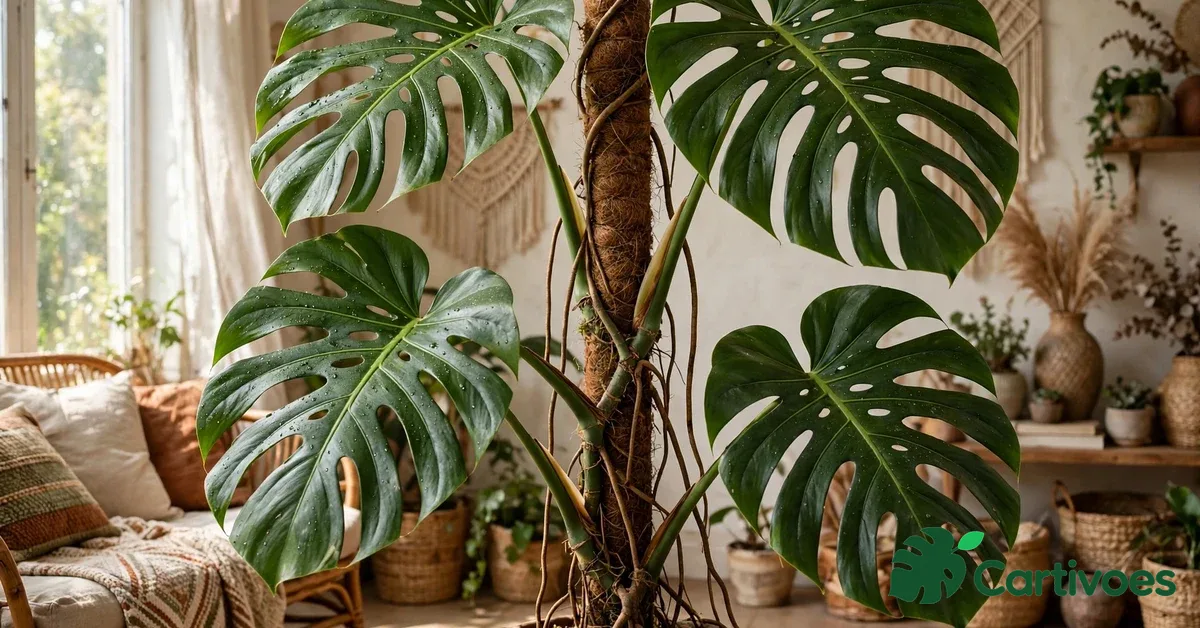
Monstera Plant Care: The Complete Swiss Cheese Guide
Every monstera care guide tells you the same four things: bright indirect light, water when dry, chunky soil, moss pole. They’re all correct — and none of them tells you why. So when your plant does something unexpected (and it will), you’re stuck guessing, because you were given rules instead of understanding.
Here’s the understanding, and it’s worth more than any checklist: in the rainforests of southern Mexico and Panama, Monstera deliciosa begins life as a seedling on the dark forest floor and spends its youth climbing toward the canopy, pressing aerial roots into tree trunks as it ascends. Botanists call this a hemiepiphyte — half earth-dweller, half tree-climber.
Nearly everything about monstera care follows from that single life story: the hunger for bright light (it’s reaching for the canopy), the aerial roots (they’re functional climbing gear, not decoration), the need for airy soil (in the wild its roots grip bark and moss, not mud), and the famous leaf splits (more on those below).
This is the flagship guide — the species-level hub that ties the whole monstera family together.
We’ll decode the four pillars of care through the plant’s rainforest logic, run a full masterclass on moss poles, explain fenestration properly (why leaves split, and the real reasons yours haven’t), walk through your plant’s first year month by month, and teach you to read its leaves like diagnostics. Understand the climber, and the care becomes obvious.
Quick Answer
Monstera plant care is simple once you think like a rainforest climber: bright indirect light (more light = bigger, more split leaves), water when the top 1–2 inches of soil dry out, a chunky aroid mix, and a moss pole to climb. Keep it at 65–85°F, feed monthly in spring and summer. It’s toxic to pets.
Monstera Plant Care: The Story Your Monstera Is Trying to Tell (Hemiepiphyte 101)
Picture the rainforest floor in Chiapas: dim, humid, carpeted with leaf litter. A monstera seed germinates here, in near-darkness, and its first leaves are small, solid, heart-shaped — nothing like the dramatic splits the plant is famous for. These juvenile leaves are built for the shade. But the seedling doesn’t stay put.
It grows toward the nearest tree trunk, and the moment it makes contact, everything changes: it becomes a climber.
As it ascends, the plant transforms. Leaves get dramatically larger. Fenestrations — the splits and holes — appear. Thick aerial roots emerge from the stem, pressing into bark for anchorage and sipping moisture from the humid air. Near the canopy, in bright filtered light, a mature monstera can produce leaves three feet across and even flower and fruit.
The plant you bought is this same organism, frozen mid-journey by life in a pot.
Now re-read every care tip you’ve ever seen through this lens: bright indirect light? That’s canopy light. A moss pole? That’s the tree trunk. Chunky, airy soil? That’s bark and moss, not forest mud. Aerial roots? Climbing equipment. Even the splits make sense up there — and we’ll get to exactly why.
When care advice is derived from the plant’s actual life instead of memorized as rules, you can improvise correctly: you’ll know why a dark corner produces small solid leaves, why a climbing monstera outgrows a trailing one, and why “more light” is the answer to half of all monstera questions.
North Carolina State Extension’s Monstera deliciosa profile tells the same origin story in botanical shorthand: a woody, perennial climbing vine of the arum family, native from Mexico to Panama, grown as a houseplant that wants sturdy support and propagation by stem cutting or layering — the climber’s toolkit.
Light: The Engine of Everything
If monstera care has a master variable, it’s light — and not just for survival. Light is the currency that buys fenestration. Every split, every hole in a monstera leaf was paid for with photons: the plant invests in elaborate leaf architecture only when it has the energy surplus to afford it.
A monstera in dim light doesn’t just grow slower; it stays forever juvenile, producing small solid leaves like the forest-floor seedling it thinks it still is.
The target is bright indirect light for most of the day — near an east window, or a few feet back from a south or west window. This is the indoor equivalent of canopy-filtered rainforest light: abundant but never harsh.
Direct hot afternoon sun through glass scorches the leaves (pale bleached patches that turn brown and crispy), while a north window or a spot deep in the room usually means small, unsplit leaves and long, reaching stems.
Two practical nuances. First, acclimate gradually: a monstera moved straight from a dim shop corner to a bright window can sunburn; shift it closer over a week or two. Second, rotate quarterly — monsteras lean hard toward light, and a quarter-turn every few months keeps growth symmetrical.
And if you’re serious about big splits, consider a grow light in winter: short dim days are when indoor monsteras stall, and a full-spectrum LED for 10–12 hours a day keeps the fenestration factory running.
Watering: Read the Soil, Not the Calendar
Monsteras are forgiving about water — they’d rather be slightly thirsty than slightly drowned — but they do have a preference: consistent, even moisture with full drainage. The rule that works in every home: water thoroughly when the top 1–2 inches of soil feel dry, until water flows from the drainage holes, then empty the saucer.
In a bright spot in summer that’s often weekly; in winter it can stretch to every two or three weeks.
NC State Extension phrases it as letting the top quarter to third of the mix dry between thorough waterings — a slightly deeper check than the fingertip test, and worth adopting once your plant is in a big pot, where the surface can mislead you.
For deep pots, learn the heft test: lift the pot after watering (heavy) and again days later (noticeably lighter = time to water). Within a month you’ll calibrate it precisely.
The two classic watering failures look different, so learn to distinguish them. Overwatering — the common one — shows as yellowing lower leaves, soft stems, and soil that never dries; left unchecked it becomes root rot, the one thing that can genuinely kill an established monstera.
Underwatering shows as curling, drooping leaves with dry, crispy edges, and soil pulling away from the pot rim; it’s dramatic-looking but the plant bounces back within hours of a good drink. When in doubt, underwater — a thirsty monstera recovers; a rotted one often doesn’t.
The Chunky Soil Recipe (and Why Roots Need Air)
Remember the tree trunk: in the wild, monstera roots grip bark and moss — materials that are wet and airy at the same time. Dense, compacted potting soil is the opposite of that: it holds water in every pore and suffocates roots. Root rot isn’t caused by water; it’s caused by water plus no oxygen.
The chunky mix solves this by building air pockets into the soil itself.
The classic recipe — equal thirds potting soil, orchid bark, and perlite — has survived decades of grower experimentation because it works. The soil holds nutrients and moisture, the bark creates structure and slow-release organic matter as it decomposes, and the perlite keeps everything open.
A handful of horticultural charcoal is a nice bonus (it absorbs impurities), and some growers swap coco coir for peat for sustainability. Whatever the exact formula, the finished mix should feel springy and open — when you squeeze a handful, it should loosely hold shape, not compact into mud.
Repot considerations: monsteras like being slightly snug — a pot 1–2 inches wider than the last is plenty, and oversized pots are just rot reservoirs. Refresh the mix every 1–2 years even without upsizing, because bark breaks down over time and the mix compacts. Spring repotting, timed with the growth surge, lets roots colonize fast.
And always — always — a pot with drainage holes.
Humidity, Temperature and Feeding
Here’s a pleasant surprise for a tropical plant: monstera is not a humidity diva. Average household humidity (30–50%) grows perfectly healthy plants; the species is far more adaptable than its rainforest passport suggests.
Higher humidity (50–60%+) does help — new leaves unfurl faster and with fewer stuck tips, aerial roots grow more enthusiastically — but it’s an optimization, not a requirement. If your winters are brutally dry, a humidifier nearby or grouping plants together helps more than misting, which evaporates in minutes.
Temperature: 65–85°F (18–29°C) is the comfort zone, and the hard floor is around 50–55°F (10–13°C) — below that, growth stops and cold damage begins. What matters more than the number is stability: keep it away from cold drafts (winter doors, leaky windows), hot blasts (radiators, heating vents), and air-conditioner streams.
A monstera sulking next to a drafty window in January isn’t sick; it’s cold.
Feeding is straightforward: a balanced liquid fertilizer at half strength, monthly, from spring through early fall — then nothing in winter. Monsteras are moderate feeders, and the chunky bark-based mix holds fewer nutrients than dense soil, so regular light feeding beats occasional heavy doses.
Pale new leaves with dark veins can signal magnesium deficiency (a pinch of Epsom salts in water, once, is the old grower’s fix); overall yellowing with stalled growth usually means it’s simply hungry — or, more often, light-starved, so check light before reaching for the bottle.
The Moss Pole Masterclass
This is the care step most people skip and the one that changes the plant most. A monstera without support grows outward and downward — sprawling, flopping, taking over floor space with ever-smaller leaves. The same plant given a pole grows upward, with leaves that get progressively larger and more fenestrated.
It’s not subtle: climbing triggers a developmental program (botanists call the climbing form’s changes heteroblasty) that literally builds a bigger, more dramatic plant.
You have two main pole types. A sphagnum moss pole — mesh tube stuffed with damp moss — is the gold standard: aerial roots grow INTO it, drinking and anchoring, which is exactly what they’d do to a tree trunk. Keep the moss damp (not soaked) and the plant treats it as an extension of the rainforest.
A coco coir pole is cheaper and tidier but coir doesn’t hold moisture the same way; roots grip it but don’t penetrate as enthusiastically. For maximum leaf size, moss wins; for tidiness and low maintenance, coir is fine.
Installation matters as much as the pole. Insert it at repotting time (driving a pole into an established root ball damages roots), positioned behind the main stem — the back of the plant, where aerial roots emerge.
Tie the stem loosely to the pole with soft plant ties or twine below each node, never cinching tight enough to dent the stem. Then guide aerial roots toward the pole: tuck them against the damp moss, and they’ll attach within weeks.
A pole installed in spring, kept lightly moist, can transform a plant’s trajectory within a single growing season.
Fenestration Explained: Why Leaves Split (and When They Don’t)
The splits and holes — fenestrations — are the whole reason most people buy a monstera, so let’s give them the explanation they deserve. In the wild, mature leaves near the canopy face two problems: wind that could shred a giant solid leaf, and light competition with the plant’s own lower leaves.
Fenestrations solve both: holes and splits let wind pass through (reducing tearing) and let dappled light filter down to the leaves below. It’s elegant engineering — the plant perforates its solar panels so the whole organism captures more energy.
Indoors, fenestration is controlled by three factors, in order of importance: maturity, light, and climbing. A young plant makes solid heart-shaped leaves — this is normal, not a defect, and no product or trick overrides it; the plant simply needs age (often 2–3 years from a juvenile cutting).
Given maturity, light is the throttle: brighter indirect light means more energy surplus to spend on elaborate leaves. And climbing support amplifies everything, because the plant’s developmental program links “upward progress” with “bigger, more divided leaves.”
So if your monstera isn’t splitting, diagnose in that order: is it mature enough (has it produced at least 8–12 leaves, with the newest notably larger than the first)? Is it getting genuinely bright indirect light — not “near a window” but several hours of strong filtered daylight? Is it climbing something? Fix the earliest missing factor first.
And reset expectations honestly: a one-year-old cutting in a north window will not produce dinner-plate splits no matter what you feed it. Give it time, light, and a pole, and the splits arrive on the plant’s schedule — which, once conditions are right, is faster than you’d think.
Your Monstera’s First Year: A Growth Timeline
New monstera owners always ask the same thing — “is this normal?” — so here’s what normal looks like across the first twelve months with a typical nursery plant:
- Months 1–2: settling in. Don’t expect much. The plant is growing roots into its new pot and acclimating to your light. A leaf or two may yellow — normal adjustment, not a crisis. Resist fertilizing until you see new growth.
- Months 3–5: the first push. Spring arrives (or your indoor conditions stabilize) and new leaves emerge — likely solid and modestly sized. This is the plant building its engine. If you haven’t added a moss pole yet, do it at the spring repot.
- Months 6–8: momentum. Leaves get visibly larger with each new one; you may see the first small fenestrations — a slit or two near the midrib. Aerial roots start reaching for the pole. Water and feed on schedule; this is peak growth season.
- Months 9–12: establishment. The plant has a rhythm now — a new leaf every 3–6 weeks in good conditions, each larger and more divided than the last. By year’s end a well-kept monstera can double in size and look like a different plant from the one you bought.
The timeline compresses with better light and stretches with worse — a monstera under a grow light can hit month-8 milestones by month 5, while one in a dim corner may still be at month 3 after a year. Light is the throttle; everything else is maintenance.
Pruning, Shaping and Repotting
Monsteras forgive pruning generously — they’re vines built to regrow after rainforest damage. Prune in spring, cutting stems just above a node with sterilized shears; the plant typically activates the bud at that node within weeks, often producing a fuller flush than before.
Remove yellowing or damaged leaves at their base, and don’t be shy about editing for shape: a monstera that’s all one long vine can be cut back by a third and will return bushier.
Every pruning is a propagation opportunity — any stem section with a node and a leaf can become a new plant (root in water or perlite, transplant at 2–3 inch roots).
And those prunings are also how you fix the two classic shape problems: the one-sided leaner (cut back the dominant vine to rebalance) and the bare-bottomed veteran (air-layer the top, then cut and replant it at soil level for a fresh start).
Repot when roots circle the pot densely or water runs straight through — typically every 1–2 years in spring, going up just one pot size. This is also the moment to install or extend the moss pole: anchor it deep in the fresh mix before the root ball goes in.
Expect a brief 2–3 week sulk after repotting; then the spring surge takes over.
Reading the Leaves: A Diagnostic Guide
Monstera leaves are remarkably communicative once you learn the dialect. Here’s the phrasebook:
- Yellow lower leaves, wet soil: overwatering — the #1 monstera killer. Let the top third dry, check drainage, inspect roots if it persists.
- Yellow leaf with brown crispy edges, dry soil: underwatering or very low humidity. Water deeply; the plant usually rebounds within a day.
- Small new leaves, no splits on a mature plant: insufficient light — the plant is economizing. Move brighter, gradually.
- Brown crispy leaf tips only: low humidity, inconsistent watering, or fluoride/salts in water. Stabilize watering; try filtered water.
- Pale bleached patches turning brown: sunburn from direct hot sun. Move back from the glass or add sheer curtains; damaged leaves won’t heal but new growth will be fine.
- Drooping but soil is moist: often cold stress or recent repotting shock — not thirst. Check temperature and give it time.
- One yellow old leaf at the bottom: natural aging. The plant retires old leaves as it grows. Worry only when it’s rapid or widespread.
The golden rule of monstera diagnostics: change one thing at a time and wait two weeks. The plant responds slowly, and owners who simultaneously repot, relocate, fertilize, and mist can’t tell which intervention worked — or which caused the new problem.
Aerial Roots: What to Do With Them
Those thick brown tentacles emerging from the stem alarm every new owner. Relax: aerial roots are normal, healthy, and useful. In the wild they anchor the plant to trees and absorb moisture from humid air. Indoors, they’re the plant reaching for a trunk that isn’t there — which is exactly why the moss pole matters.
You have three good options. Best: guide them to the pole — tuck long aerial roots against the damp moss pole or into the soil surface, where they’ll anchor and even feed the plant. Fine: trim them — cutting aerial roots doesn’t harm the plant (use clean shears; it may ooze a little sap).
Avoid: letting a dozen of them dangle into your living space collecting dust — it’s untidy and a missed opportunity. What you should never do is rip them off by hand; a tear wounds the stem, while a clean cut heals neatly.
One more use for aerial roots: they’re propagation accelerators. A cutting taken with a long aerial root already attached roots in days instead of weeks, because the root tissue just needs to adapt, not form from scratch. When choosing where to prune for cuttings, always favor the node with the most developed aerial root.
Pests: The Usual Suspects
Healthy monsteras are notably pest-resistant — NC State Extension lists no significant problems — but stressed or dusty plants attract the standard indoor lineup. Spider mites love dry, dusty conditions: look for fine webbing where leaf meets stem and a dull stippled speckling on leaf surfaces.
Mealybugs appear as white cottony clusters in leaf axils; scale as small brown bumps along stems and undersides, often with sticky honeydew below.
Prevention beats treatment, and it’s simple: wipe the big leaves monthly with a damp cloth (both sides — pests colonize undersides). Dust blocks light and harbors mites; a clean leaf is a defended leaf.
For active infestations, start with the gentle arsenal: a strong shower to dislodge pests, then insecticidal soap or neem oil applied thoroughly (including undersides) and repeated weekly for three weeks to catch hatching eggs. Dab individual mealybugs and scale with rubbing alcohol on a cotton swab.
Reserve systemic insecticides for severe cases — most monstera pest problems resolve with soap, persistence, and better growing conditions.
Pet Safety: Calcium Oxalate Crystals
The fine print, stated plainly: all monstera species are toxic to cats, dogs, and humans if chewed. The culprit is insoluble calcium oxalate crystals — microscopic needle bundles (raphides) in every leaf, stem, and root. Chewing fires these needles into mouth tissue: immediate burning, drooling, pawing at the mouth, vomiting, and difficulty swallowing.
It’s painful but rarely life-threatening; still, prevention is the entire strategy.
Placement solves most of it: monsteras are floor plants by nature, so think vertically — train the plant up its moss pole rather than letting vines trail where pets investigate, and keep smaller specimens on sturdy high stands. For dedicated plant-chewers (some cats are relentless), physical barriers or a different room may be needed.
And teach the household rule: the sap that oozes from cut stems can irritate skin too, so wear gloves when pruning.
Check monstera — listed as Swiss cheese plant / split-leaf philodendron — against the ASPCA’s toxic and non-toxic plants database by exact species name before it comes home, especially in multi-pet households.
Which Monstera Do You Have? (Meet the Family)
Monstera deliciosa is the famous one, but it’s the flagship of a whole fleet — and several relatives have their own dedicated guides in this collection. Knowing which you own (or want next) changes the care details:
- Monstera deliciosa (this guide): the classic — big, bold, fenestrated, forgiving. The baseline everything else is compared to.
- Variegated deliciosa — Thai Constellation & Albo: same care, more light needed (white sections can’t photosynthesize), slower growth, much higher stakes. See the Thai Constellation and Albo guides.
- Monstera adansonii: the “Swiss cheese vine” — smaller, fully holed leaves, vining habit that loves to trail or climb. Faster-growing and even more forgiving.
- Monstera peru, siltepecana & esqueleto: the collector’s trio — quilted, silver, and skeleton leaves respectively, each with its own climbing personality and care quirks.
- Mini monstera (Rhaphidophora tetrasperma): not a monstera at all botanically, but the same care playbook applies — bright light, a pole, chunky mix.
The beautiful thing: master deliciosa and you’ve mastered 90% of every monstera. The genus shares the same rainforest-climber logic; the varieties just tune the parameters — more light for variegation, more humidity for the thin-leaved species, more patience for the slow ones. Start here, then branch out.
Key Takeaways
- Think like a rainforest climber: Monstera deliciosa is a hemiepiphyte — born on the forest floor, built to climb toward the canopy. Bright light, climbing support, and airy soil aren’t random tips; they’re the plant’s native habitat, recreated.
- The four pillars: bright indirect light (the engine of growth and fenestration) — water when the top 1–2 inches dry — chunky aroid mix (equal parts potting soil, orchid bark, perlite) — a moss pole or sturdy support to climb.
- Fenestration = maturity + light + climbing. Young plants make solid leaves normally; splits arrive with age (often 2–3 years), brighter light, and a pole. Diagnose missing splits in that order.
- Moss pole masterclass: install at repotting time behind the main stem, tie loosely below nodes, keep sphagnum moss lightly damp, and guide aerial roots to it. Moss beats coir for root penetration and leaf size.
- Read the leaves: yellow + wet = overwatering; small unsplit new leaves = too little light; bleached patches = sunburn; single yellow old leaf = natural aging. Change one thing at a time and wait two weeks.
- First-year rhythm: months 1–2 settling, 3–5 first push, 6–8 momentum with first slits, 9–12 established — a new leaf every few weeks, each bigger than the last.
- Toxic to pets (calcium oxalate crystals in all parts) — train upward on the pole, keep out of chewing range, verify on the ASPCA database.
Conclusion
Most monstera advice is a list of rules to memorize. This guide tried to give you something better: the reason behind the rules.
A monstera is a rainforest climber interrupted mid-journey — give it canopy light, a trunk to climb, bark-like soil, and the patience to mature, and it does what it evolved to do: grow upward, grow large, and perforate its leaves like green lace.
Start where you are. If your plant is young and solid-leaved in a dim corner, you don’t have a problem — you have a seedling waiting for its cue. Move it brighter, give it a pole this spring, water by soil not by calendar, and watch what happens over the next twelve months.
The first fenestrated leaf feels like a personal achievement, and in a way it is: you didn’t just keep a plant alive, you understood it. That’s the whole game, and now you know how to play.
Related Articles
- Monstera Adansonii: The Climber’s Guide to a Thriving Swiss Cheese Vine — more on monstera adansonii — the monstera adansonii guide.
- Mini Monstera: The Climbing Guide to Splits & Moss Poles — more on mini monstera — the mini monstera guide.
- Swiss Cheese Monstera: Complete Care & Buying Guide — more on swiss cheese monstera — the swiss cheese monstera guide.
- How to Propagate Monstera: 4 Methods That Actually Work — more on how to propagate monstera — the how to propagate monstera guide.
Frequently Asked Questions
Fenestration needs three things in order: maturity, light, and climbing support. Young plants produce solid leaves for the first 1–3 years — that’s normal, not a defect. Once mature, brighter indirect light is the throttle: dim plants stay juvenile because they lack the energy for elaborate leaves. A moss pole amplifies everything, since climbing triggers bigger, more divided leaves. Diagnose in order — age, then light, then support.
When the top 1–2 inches of soil feel dry — weekly in a bright spot in summer, every 2–3 weeks in winter. Always water until it drains from the bottom and empty the saucer; shallow sips cause more problems than drinks. For large pots, check deeper — the top quarter to third of the mix. Never water on a calendar: light, pot size, and season change the interval.
It can survive without one, but it won’t reach its potential. A supported monstera grows upward with larger, more fenestrated leaves; an unsupported one sprawls outward with smaller leaves and takes over space. A sphagnum moss pole is the gold standard (aerial roots grow into moss like a tree trunk); coco coir poles are tidier but less effective. Install at repotting time and tie the stem below nodes.
The most common cause is overwatering: yellow lower leaves plus damp soil means roots are suffocating — let the top third dry out and check drainage. A yellow leaf at the bottom is natural aging — ignore it. Yellowing with crispy edges and dry soil points to underwatering or low humidity. Yellow new growth can mean the plant is hungry (feed in growing season) or, more often, light-starved.
Yes — all monstera species are toxic to cats and dogs. Every part contains insoluble calcium oxalate crystals (raphides), microscopic needles that cause immediate mouth burning, drooling, pawing at the mouth, vomiting, and difficulty swallowing when chewed. Keep monsteras out of chewing range (train them up a moss pole, use high stands), wear gloves when pruning, and verify the exact species on the ASPCA’s toxic and non-toxic plants database.
With light and support, expect 6–8 feet indoors within a few years — and they keep going; in the wild they reach 60–70 feet. Growth rate depends mostly on light: a plant in bright indirect light with a moss pole can add a leaf every 3–6 weeks in growing season, while one in a corner barely grows. Prune in spring to control size, and repot every 1–2 years.

Grace Miller is an indoor gardening specialist with over 10 years of hands-on experience growing — and rescuing — houseplants, from low-light apartments to a 200+ plant indoor jungle. Every care routine on Cartivoes is tested on her own collection first. She writes practical, beginner-friendly guides on monstera, snake plants, pothos and low-light plants, with a focus on what actually works in real homes.