
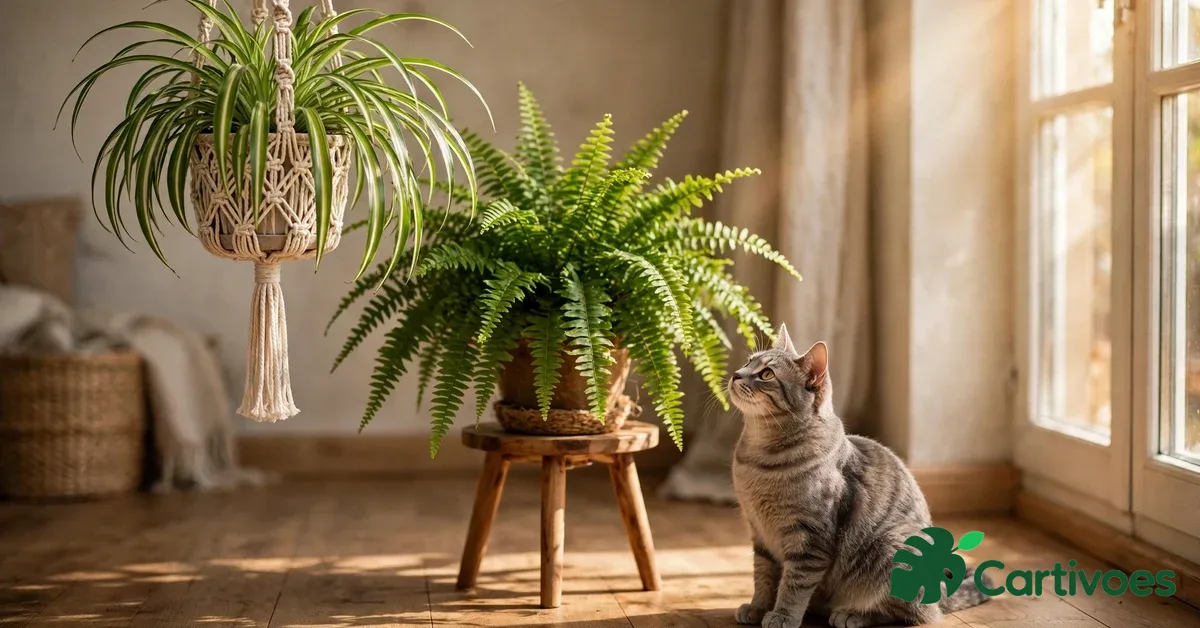
Houseplants Safe for Cats: 14 Non-Toxic Plants & the Cat-Proof Setup
Every cat owner who loves plants eventually faces the same quiet panic: the cat is chewing the leaves again, and Google says everything is either “toxic” or “probably fine,” which is not helpful at 11pm. Here’s the calmer truth — you don’t have to choose between a green home and a safe cat.
You just need to know which plants are which, and how to set them up so the chewing never becomes a crisis.
This guide is built on the ASPCA’s toxic and non-toxic plant database — the gold standard that veterinarians actually use — not on Pinterest lists copied from Pinterest lists.
You’ll get 14 genuinely cat-safe houseplants worth owning (not just surviving), the dangerous lookalikes people buy by mistake, a cat-proofing playbook for placement, the cat-grass decoy strategy that actually redirects chewing, room-by-room picks, a toxic hall of fame with real symptoms, and a clear emergency protocol for the night your cat eats something it shouldn’t.
One important framing before we start: “non-toxic” doesn’t mean “edible.” It means the plant contains no compounds known to poison cats. A cat that inhales a whole salad bowl of any leaf can still vomit — that’s mechanical irritation, not poisoning, and it’s an important distinction. Safe plants plus smart setup is the goal. Let’s build it.
Quick Answer
The safest houseplants safe for cats — all verified non-toxic on the ASPCA list — include spider plant, Boston fern, parlor palm, calathea, prayer plant, peperomia, African violet and moth orchid. Avoid true lilies (fatal kidney failure), sago palm, pothos and ZZ plant. Still keep plants out of heavy chewing range and offer cat grass.
Houseplants Safe for Cats: What “Cat-Safe” Actually Means
Let’s define the term properly, because the internet uses it loosely. When the ASPCA lists a plant as “non-toxic to cats,” it means the plant contains no compounds known to cause systemic poisoning in felines — no calcium oxalate crystals that burn the mouth, no cardiac glycosides, no kidney-destroying lily toxins.
It’s a toxicology verdict, and it’s the only definition worth using.
What it does NOT mean: that the plant is food, that unlimited chewing is harmless, or that your cat will feel great after eating half a fern. Plant fiber irritates stomachs mechanically — a cat that gorges on even a perfectly safe spider plant may vomit, the same way it would after eating too much grass outside.
Vomiting after a binge is unpleasant, not poisoning, and it resolves on its own. Keep that distinction in your head and you’ll never panic unnecessarily — or under-react when it actually matters.
The ASPCA’s Toxic and Non-Toxic Plant List for Cats is the database everything in this guide is checked against. It’s searchable, it’s maintained by the ASPCA’s Animal Poison Control Center, and it’s what your vet will consult if you ever call in a panic. Bookmark it. Before any new plant crosses your threshold, search its botanical name there — common names overlap dangerously, as you’ll see in the confusable-pairs section below.
One more foundational point: toxicity is about the plant’s chemistry, not its spikiness or smell. A cactus is “safe” in the ASPCA sense but will still hurt a curious nose — common sense still applies. And individual cats vary: a cat with kidney disease or on certain medications may react worse to mild irritants.
When in doubt, your vet knows your cat; the list knows the plants. Use both.
The Hanging Trio: Spider Plant, Boston Fern & Hoya
If you want the single best starter plant for a cat home, it’s the spider plant (Chlorophytum comosum) in a hanging basket. It’s the rare plant that is non-toxic, nearly indestructible, genuinely attractive with its arching striped leaves, and — here’s the kicker — cats find it fascinating.
The dangling leaves and baby plantlets trigger the same instincts as grass. Hang it where the cat can bat at a leaf or two without reaching the pot, and you’ve turned a risk into enrichment.
The Boston fern (Nephrolepis exaltata) is the lush alternative: feathery, dramatic, and completely non-toxic. It loves the humidity of a bathroom and the indirect light of an east window, and its soft fronds are far less tempting to chew than strappy leaves.
The one caution is horticultural, not toxicological — ferns want consistent moisture and hate dry heated air, so it’s a plant for owners who’ll actually water it. Note the fine print the rescue organizations stress: only TRUE ferns are safe. Asparagus fern isn’t a fern at all, and it IS toxic. Buy Nephrolepis, not Asparagus.
The hoya — wax plant, Hoya carnosa — is the sleeper pick. Thick, waxy leaves that cats generally ignore (uninteresting texture, no dangling temptation), fragrant star-shaped flowers when it’s happy, extreme tolerance for neglect, and an ASPCA non-toxic listing. It trails beautifully from a high shelf, wants bright indirect light, and prefers to dry out between waterings.
For the owner who wants a vine without the worry, hoya is the answer — compare that to pothos and philodendron, the two most popular vines in the world, both toxic to cats.
Floor Statements: Parlor Palm, Areca Palm & Cast Iron Plant
Big floor plants are the hardest category to make cat-safe, because a cat can reach every frond without even jumping. The parlor palm (Chamaedorea elegans) solves it: elegant, feathery, slow-growing, tolerant of the low light in corners, and non-toxic to cats and dogs alike.
It’s been a Victorian parlor staple for over a century precisely because it survives neglect — low light, irregular watering, dry air — while looking refined. A parlor palm in a heavy pot in a corner is a ten-year solution, not a ten-month one.
The areca palm (Dypsis lutescens) is the bigger, bolder statement — multiple feathery fronds on bamboo-like stems, genuinely tropical-looking, and equally non-toxic. It wants brighter light than the parlor palm and more consistent watering, but it rewards you with faster growth and real presence.
Use a heavy, wide-based pot; a climbing cat can topple a tall plant in a light container, and the injury from the fall is worse than any leaf.
The cast iron plant (Aspidistra elatior) is the tank of the cat-safe world. Dark, broad, leathery leaves that survive deep shade, missed waterings, and — relevant here — chewing. Cats find the tough, upright leaves uninteresting, and even an enthusiastic nibble does no harm.
It grows slowly and asks for almost nothing, which makes it the perfect plant for the hallway, the dark corner behind the sofa, or any spot where you want green without a maintenance contract.
The Bloomers: African Violet, Christmas Cactus & Moth Orchid
Cat-safe doesn’t have to mean foliage-only. African violets (Saintpaulia) bloom for months in fuzzy purple, pink, or white on a compact rosette that fits any windowsill — and they’re fully non-toxic.
They want bright indirect light and careful bottom-watering (cold water on the leaves spots them), but their small size means you can keep them on a high shelf entirely out of the fray while they flower their hearts out.
The Christmas cactus (Schlumbergera) is the holiday plant you don’t have to banish. Unlike the genuinely dangerous holiday plants — lilies first among them — it blooms in spectacular winter color and the ASPCA lists it as non-toxic. It’s a succulent-like forest cactus, so it wants bright indirect light and a drink when the top inch dries out.
Hang it or shelf it; the segmented stems trail beautifully and the flowers stop houseguests mid-sentence.
Moth orchids (Phalaenopsis) deserve a special mention because they’re the flowering houseplant most people already own — and the one they worry about most. Relax: the ASPCA lists them as non-toxic to cats. A chewed flower spike is a tragedy for the orchid, not the cat.
Keep orchids where the blooms can be admired without becoming toys, and you get months of flowers with zero toxicity anxiety.
Succulent-Likes: Haworthia, Echeveria & Peperomia
Succulent lovers with cats face a minefield — jade plant, aloe, kalanchoe, and string of pearls are all toxic — but the safe list is better than most people think. Haworthia (the zebra-striped Haworthia fasciata especially) looks like a miniature aloe, loves a sunny windowsill, thrives on neglect, and is completely non-toxic.
It’s the plant to buy when you want the aloe LOOK without the aloe risk.
Echeveria — those perfect rosettes in dusty blue-green, sometimes blushed pink — is likewise non-toxic and endlessly collectible. They want strong light and a gritty, fast-draining mix, and they’ll reward a bright sill with tight, symmetrical rosettes. A cluster of echeverias in a shallow dish is a whole succulent garden your cat can sniff safely.
Peperomias are the wildcard: over a thousand species in every texture from watermelon-striped to ripple-leafed to the thick, glossy baby rubber plant (Peperomia obtusifolia) — all non-toxic, all compact, all easy.
They’re the ideal desk and shelf plants for cat homes: small enough to place out of reach, interesting enough to satisfy the plant collector, and safe enough that a knocked-over pot is a mess, not an emergency.
The Prayer-Plant Family: Maranta, Calathea & Stromanthe
If you want drama without danger, the Marantaceae family is your playground. Prayer plants (Maranta leuconeura) fold their patterned leaves upward at night like hands in prayer — a daily performance cats find mildly interesting and completely safe to watch. Calatheas bring the most spectacular foliage patterns in the houseplant world: rattlesnake stripes, peacock feathering, pinstripes.
Stromanthe ‘Triostar’ adds pink-and-cream variegation that looks almost artificial in its perfection.
The honest trade-off: these are the divas of the safe list. They want consistent moisture, higher humidity, and protection from direct sun and tap-water chemicals (brown edges are their complaint letter). A bathroom with a window, or a humidifier nearby, keeps them happy.
But for the owner willing to meet their needs, they prove the central thesis of this guide — you don’t sacrifice beauty for safety. The most beautiful leaves you can grow indoors happen to be cat-safe.
Don’t Buy the Wrong Plant: 5 Confusable Pairs
More cat poisonings come from mistaken identity than from deliberate risk-taking. Common names are a mess — the same name gets slapped on unrelated plants, and “palm” or “lily” on a tag tells you almost nothing. Memorize these five pairs before you shop:
| You Want (Safe) | Don’t Accidentally Buy (Toxic) | How to Tell |
|---|---|---|
| Parlor palm (Chamaedorea elegans) | Sago palm (Cycas revoluta) — NOT a true palm | Sago has a thick scaly trunk and stiff feather fronds; all parts can cause liver failure. Check the botanical name. |
| Boston fern (Nephrolepis exaltata) | Asparagus fern (Asparagus densiflorus) | Asparagus ‘fern’ has needle-like cladodes, often with red berries. True ferns have soft divided fronds. |
| Baby rubber plant (Peperomia obtusifolia) | Rubber plant (Ficus elastica) | Peperomia: small, thick cupped leaves, no sap. Ficus: large leathery leaves, milky latex sap, grows into a tree. |
| Swedish ivy (Plectranthus verticillatus) | English ivy (Hedera helix) | English ivy has lobed, pointed leaves and climbs with aerial roots; it’s toxic. Swedish ivy has rounded scalloped leaves. |
| Moth orchid (Phalaenopsis) | Any true lily (Lilium spp.) | Lilies have prominent stamens and trumpet/funnel flowers — and can kill a cat. When in doubt, no lilies, ever. |
The rule that prevents every one of these mistakes: shop by botanical name, not common name. The Latin name on the nursery tag is the plant’s fingerprint — search exactly that on the ASPCA list. If the tag only says “tropical foliage” or “assorted palm” and nobody in the store can tell you the species, walk away.
A mystery plant in a cat home is a gamble with terrible odds.
Safe Plant, Smart Placement: The Cat-Proofing Playbook
Here’s the part the listicles skip: even non-toxic plants need a placement strategy, because a determined cat can destroy a plant (and redecorate your floor with soil) without being poisoned. The goal isn’t just non-toxic — it’s non-toxic AND positioned so the cat loses interest.
- Height is your first tool. High shelves, hanging baskets, and wall-mounted planters put plants in the visual-but-unreachable zone. A spider plant in a macramé hanger is enrichment; the same plant on a low table is a salad bar.
- Weight is your second tool. Floor plants need heavy, wide-based pots — ceramic or concrete, not light plastic. A cat that can’t topple it will investigate once and move on.
- Texture deterrents work. Cats dislike sticky, rough, or unstable surfaces. Double-sided tape on the pot rim, aluminum foil on the soil surface, or a layer of large decorative stones over the soil discourages digging and lounging.
- Taste deterrents help. Bitter apple spray on leaves is the classic; citrus peels on the soil work for some cats. Reapply after watering.
- Never use toxic deterrents. Mothballs, essential oils, and chemical sprays are more dangerous to your cat than any plant. If a deterrent isn’t cat-safe, it’s not a solution.
And the nuclear option for the truly obsessed chewer: a dedicated plant room or a glass cabinet (the IKEA greenhouse-cabinet trend exists for exactly this reason). There’s no shame in admitting your cat has defeated every other strategy. Containment is a valid cat-proofing philosophy.
The Cat Grass Decoy Strategy
Here’s the insight most plant guides miss: cats don’t chew plants to annoy you. They chew because the urge to gnaw greenery is ancient — wild felines eat grass to aid digestion and expel hairballs. You can’t train the instinct out, but you can redirect it.
Enter the decoy: a pot of cat grass (usually wheat, oat, or barley grass) placed at cat level, explicitly FOR the cat, while the decorative plants live up high.
The psychology works because cats are surprisingly rule-respecting once an alternative exists. Put the grass pot where the cat already hangs out — near the sunny window, by the favorite napping spot — and most cats transfer their chewing within days.
Grow it yourself from seed (a $3 bag of wheatgrass seed and a shallow pot, ready in a week) and keep two pots in rotation so there’s always a fresh one. Catnip plants work as a decoy too, though they tend to produce a cat that’s too blissful to chew anything.
Pair the decoy with gentle redirection: when you catch the cat on the spider plant, move it to the grass with zero drama. No yelling, no spray bottles — punishment teaches cats to chew when you’re not looking, which is worse. Boring consistency (plant is unavailable, grass is available) wins within a couple of weeks in most households.
Room-by-Room Picks for Cat Homes
Different rooms have different light, humidity, and cat-traffic patterns. Here’s how to match safe plants to real rooms instead of buying generically:
- Living room (bright, high traffic): parlor palm or areca palm in a heavy pot as the anchor; spider plant in a hanging basket; African violets on a high shelf. This is the showroom — pick the prettiest safe plants and place them deliberately.
- Bedroom (low-medium light, cat sleeps here): cast iron plant in the dark corner; prayer plant or calathea on the dresser (cats love watching the leaves move at night); moth orchid on the nightstand, out of paw range.
- Bathroom (humid, bright-ish): Boston fern — this is its dream habitat; calathea or maranta for the humidity they crave. Keep the door’s cat-flap in mind: bathrooms are small, so hang or shelf everything.
- Kitchen (bright, warm, tempting): herbs the cat can share — cat grass, plus spider plant hung high. Avoid the windowsill herb garden unless every herb is verified; many culinary herbs are fine, but check each one.
- Home office (your desk, cat’s second desk): peperomia or haworthia on the desk — small, safe, and knock-resistant in a heavy little pot. The cat will sit on your keyboard anyway; at least the plant survives.
The Toxic Hall of Fame: 12 Plants to Rehome
Now the other side of the ledger. These are the most common houseplants that are genuinely dangerous to cats — the ones to move to a cat-free room, give away, or replace. Knowing the SYMPTOMS matters, because it tells you how urgently to act:
| Plant | Toxin / Mechanism | What Happens to a Cat |
|---|---|---|
| True lilies (Lilium spp.) | Unknown nephrotoxin | Kidney failure — can be FATAL. Even pollen counts. |
| Sago palm (Cycas revoluta) | Cycasin | Vomiting, liver failure — potentially fatal; seeds worst |
| Pothos (Epipremnum aureum) | Calcium oxalate crystals | Mouth/throat burning, drooling, vomiting, swallowing difficulty |
| Philodendron (all) | Calcium oxalate crystals | Same as pothos: oral pain, drooling, vomiting |
| Dieffenbachia (dumb cane) | Calcium oxalate + enzymes | Intense mouth swelling, drooling; can obstruct airway |
| Peace lily (Spathiphyllum) | Calcium oxalate crystals | Mouth irritation, drooling, vomiting (NOT a true lily) |
| ZZ plant (Zamioculcas) | Calcium oxalate crystals | Oral irritation, vomiting |
| Aloe vera | Saponins, anthraquinones | Vomiting, diarrhea, tremors, lethargy |
| Jade plant (Crassula ovata) | Unknown | Vomiting, depression, incoordination |
| Dracaena (all) | Saponins | Drooling, vomiting, dilated pupils, weakness |
| Kalanchoe | Cardiac glycosides | Vomiting, diarrhea; large amounts affect heart rhythm |
| Asparagus fern | Sapogenins + berries | Vomiting, diarrhea, skin irritation |
Clemson Extension’s pothos factsheet states the mechanism plainly: all parts of pothos contain calcium oxalate crystals that irritate mouth and throat, cause vomiting and difficulty swallowing — which is why it explicitly advises keeping pothos out of reach of pets. The same crystals are behind most of the “burning mouth” plants on this list.
If you currently own any of these and have a cat: don’t panic, but do act. Move the plant today — to a closed room, a high locked cabinet, or a friend’s cat-free home — and replace it with something from the safe list.
“My cat has never touched it” is the most famous last sentence in plant-cat history. Cats live 15+ years; curiosity compounds.
Lilies Deserve Their Own Warning
Lilies get their own section because they’re in a category of one: the most dangerous common plant for cats, by far. True lilies — Easter lily, tiger lily, Asiatic lily, daylily, stargazer — contain an unidentified toxin that destroys feline kidneys.
A cat that nibbles a petal, laps vase water, or even grooms pollen off its fur can develop fatal kidney failure within 36 to 72 hours. This isn’t a “might cause vomiting” situation; it’s a genuine emergency where hours matter.
The cruel part is how innocent they look. Lilies arrive as gifts, in Easter bouquets, in funeral arrangements — nobody thinks of the centerpiece as a weapon. So make it a household rule, communicated to every gift-giver: no lilies in a cat home, ever, not even in a “high” vase. (Cats jump. Vases fall.
Pollen drifts.) If a lily enters the house by mistake and the cat may have contacted it, this is a rush-to-the-emergency-vet situation, not a wait-and-see one — and bring the flower or a photo so the vet can identify it.
Name-confusion adds to the danger: peace lilies and calla lilies are NOT true lilies (they’re calcium-oxalate irritants, unpleasant but not kidney-killers), while “lily” in daylily and tiger lily means the real thing. When someone says “lily,” assume the worst until the botanical name says otherwise.
This is the one plant category where zero tolerance is the only sane policy.
If Your Cat Eats Something: The First 30 Minutes
Despite every precaution, it can happen — a knocked-over pot, a gifted bouquet, a new roommate’s plant. What you do in the first half hour matters enormously. Memorize this sequence now, while everyone’s calm:
- Identify the plant. Photograph it, including any tag. The botanical name determines everything — treatment for lily exposure is completely different from treatment for pothos nibbling. No photo, no tag? Bag a leaf sample for the vet.
- Check the ASPCA list immediately. Search the botanical name on the ASPCA toxic/non-toxic database. It tells you the toxin, the expected symptoms, and the urgency — the exact information the vet will want.
- Call your vet or the ASPCA Animal Poison Control hotline. Don’t wait for symptoms with high-risk plants (lilies, sago palm). For mild irritants, the vet may advise monitoring at home — but let a professional make that call, not your anxiety.
- Do NOT induce vomiting. This is the mistake panicked owners make. Vomiting up calcium oxalate crystals burns the throat twice; some plant compounds cause more damage coming back up. Never induce vomiting unless a veterinarian explicitly instructs it.
- Watch and document. Note the time of ingestion, the amount eaten, and every symptom with its time. Drooling and pawing at the mouth suggest oxalates; vomiting and lethargy suggest systemic toxins; increased thirst and urination changes suggest kidney involvement (lilies). Bring your notes to the vet.
The symptoms that mean “emergency vet NOW, not in the morning”: repeated vomiting, difficulty breathing or swallowing, extreme lethargy or collapse, tremors or seizures, and — for any suspected lily exposure — anything at all, even if the cat looks fine.
Kidney damage from lilies is silent for the first 12–24 hours, which is exactly why waiting is dangerous. When in doubt, go. An unnecessary vet visit costs money; a delayed one can cost the cat.
Living With a Chronic Plant-Chewer
Some cats are casual investigators; others are committed herbivores who will defeat every deterrent known to science. If yours is the second type, stop fighting the instinct and design around it. The chronic chewer’s home runs on three principles: everything chewable is non-toxic, everything toxic is physically inaccessible, and there’s always a legal outlet.
The legal outlet is doing more work than you think. A fresh pot of cat grass, rotated weekly so it never gets manky, satisfies the chewing drive for most cats — many owners report the decorative plants become boring by comparison once the grass is established.
Add a second pot of catnip for the cats motivated by scent rather than texture. And consider WHY the cat chews: boredom chewers need more play (a tired cat is a non-chewing cat), while anxious chewers may need routine, hiding spots, or a vet conversation. The plant is often the symptom, not the disease.
For the truly unstoppable: grow the safe plants the cat loves most as sacrificial offerings. A pot of spider plant babies on the floor, explicitly the cat’s, while the specimen plants live behind glass. It sounds like surrender; it’s actually strategy. The cat gets its greenery, you keep your collection, and everyone stops being frustrated with each other.
Kittens, Seniors & Multi-Cat Homes
Age changes the equation. Kittens are the highest-risk group — they explore the world mouth-first, can reach surprising heights, and their small body weight means a smaller dose does more damage. In a kitten home, be stricter than this guide’s baseline: hang everything, lock away anything questionable, and assume the kitten will find the one plant you forgot.
Kitten-proofing is temporary; they grow out of the worst of it by 12–18 months.
Senior cats flip the risk profile. An older cat with early kidney disease — extremely common in cats over 12 — is more vulnerable to even mild toxins, and a nauseous senior may stop eating, which cascades quickly.
If your vet has mentioned kidney values, upgrade your caution a level: stick to the safest of the safe (spider plant, parlor palm, Boston fern), keep everything else out of reach, and mention new plants at vet visits.
Multi-cat homes multiply the variables: the cats teach each other. One chewer becomes two within weeks — cats are observational learners, and “the spider plant is delicious” is exactly the kind of intelligence they share.
In multi-cat households, standardize on the safe list for every plant in common areas, and keep any toxic specimens in a room with a door that latches. A baby gate won’t stop a cat; a closed door will.
Beyond Cats: Dogs and Kids Overlap
Good news for mixed households: the ASPCA maintains parallel lists, and the overlap between cat-safe and dog-safe is large. Nearly every plant in this guide’s safe list — spider plant, palms, ferns, calatheas, peperomias, African violets, haworthia, cast iron plant — is non-toxic to dogs as well.
The toxic lists overlap heavily too: lilies (less deadly to dogs than cats, but still bad), sago palm (extremely dangerous to dogs — it’s one of the top canine plant poisonings), pothos, dieffenbachia, and ZZ plant are toxic to both.
Toddlers add a different dimension: anything at grabbing height will be grabbed, mouthed, and possibly eaten in quantity. The non-toxic list still applies — a swallowed spider plant leaf won’t poison a toddler — but choking hazards (small pots, pebble top-dressings, moss poles with ties) and soil ingestion matter too.
For the under-three crowd, hanging and high-shelf placement isn’t just cat-proofing; it’s everything-proofing. And keep the poison control number on the fridge regardless of how safe your plants are — it’s the same call you’d make for a swallowed Lego.
The Pre-Purchase Checklist
Make this a habit and you’ll never bring home a problem. Before any plant crosses your threshold — nursery, grocery store, friend’s cutting, online order — run the checklist:
- Get the botanical name. Read the tag. No tag? Ask. No answer? Don’t buy it — mystery plants don’t enter cat homes.
- Search it on the ASPCA list. Takes 30 seconds on your phone in the store aisle. Non-toxic to cats = proceed; toxic = put it back, no matter how pretty.
- Check the lookalikes. If it’s a “palm,” confirm it’s a true palm. If it’s a “fern,” confirm it’s a true fern. If it’s a “lily,” run.
- Plan the placement before you pay. Where will it live out of enthusiastic-chewing range? If you can’t answer, you’re buying a problem.
- Inspect for pests. A safe plant covered in pesticide residue isn’t safe. Quarantine new plants for two weeks, rinse the leaves, and ask the seller about recent sprays.
- Tell the household. Everyone — partners, kids, roommates, the cat sitter — should know which plants are which and where the ASPCA list lives. The checklist only works if the whole house follows it.
Key Takeaways
- “Non-toxic” is a toxicology verdict, not an edibility certificate: the ASPCA list means no poisoning risk — but any binge-chewed leaf can still cause vomiting. Safe plants + smart placement is the formula.
- The 14 safe stars: spider plant, Boston fern, hoya, parlor palm, areca palm, cast iron plant, African violet, Christmas cactus, moth orchid, haworthia, echeveria, peperomia, prayer plant, and calathea — all ASPCA-verified non-toxic to cats.
- Shop by botanical name: parlor palm vs sago palm, true ferns vs asparagus fern, baby rubber plant vs rubber plant — common names lie; Latin names don’t.
- Zero tolerance for lilies: true lilies can cause fatal kidney failure in cats from a nibble, vase water, or even pollen. No lilies in a cat home, ever.
- Redirect, don’t just forbid: a pot of cat grass at cat level satisfies the ancient chewing instinct and protects your decorative plants better than any deterrent.
- Know the first-30-minutes protocol: identify the plant, check the ASPCA list, call the vet — and never induce vomiting unless a vet says so.
- Run the pre-purchase checklist: botanical name → ASPCA search → lookalike check → placement plan → pest inspection. Every plant, every time.
Conclusion
A home with both cats and plants isn’t a compromise — it’s one of the best kinds of homes. The safe list in this guide isn’t a list of boring consolation prizes; it’s spider plants cascading from hangers, calatheas unfolding patterned leaves every morning, parlor palms standing elegant in corners, orchids blooming for months.
Nobody walking into your living room will think “oh, the cat-safe collection.” They’ll just think it’s beautiful.
The work is front-loaded: learn the list, check the names, set up the placements, plant the decoy grass. After that, it runs itself — a quick ASPCA search before each new purchase, a glance at the grass pot’s freshness, and otherwise just enjoying the green. Your cat gets a jungle to supervise. You get a jungle to tend.
And the 11pm leaf-chewing panic becomes a story you tell about the old days, before you knew which plants were which.
Related Articles
- Is Monstera Toxic to Cats? The Complete Safety Guide — the deep dive on one specific danger — monstera toxicity symptoms, what to do, and safe alternatives.
- Spider Plant Care: Running the Cheerful Baby Factory at Home — care guide for the #1 cat-safe pick — light, water, and endless free baby plants.
- Prayer Plant Care: The Complete Guide to a Happy, Praying Maranta — care guide for another safe beauty — the folding leaves cats love to watch.
- Pothos Plant Care: The Beginner’s Guide to the Vine That Forgives Everything — the popular vine to keep AWAY from cats — know it so you can spot the risk.
Frequently Asked Questions
ASPCA-verified safe houseplants include spider plant, Boston fern, parlor palm, areca palm, cast iron plant, calathea, prayer plant (maranta), peperomia, African violet, Christmas cactus, moth orchid, haworthia, echeveria, and Swedish ivy. Always verify by botanical name on the ASPCA’s toxic and non-toxic plant list before buying, since common names can be misleading.
Yes — the spider plant (Chlorophytum comosum) is listed as non-toxic to cats by the ASPCA, and it’s one of the best cat-home plants overall: tough, attractive, and easy to hang out of reach. Interestingly, many cats are drawn to its dangling leaves, possibly due to mild compounds in the foliage — but ingestion causes no poisoning, at most mild stomach upset from overindulgence.
Yes. All parts of pothos (Epipremnum aureum) contain insoluble calcium oxalate crystals that burn a cat’s mouth and throat, causing drooling, pawing at the mouth, vomiting, and difficulty swallowing. Clemson Extension explicitly advises keeping pothos out of reach of pets. If your cat chews pothos, rinse the mouth if you safely can and call your vet.
The spider plant wins for most homes: non-toxic, nearly indestructible, tolerant of varied light, and perfect in a hanging basket where cats can bat at it safely. Runners-up: parlor palm for low-light corners, Boston fern for bathrooms, and hoya for a trailing vine — all ASPCA-verified non-toxic and genuinely good-looking plants.
Extremely — true lilies (Easter, tiger, Asiatic, daylily, stargazer) are the most dangerous common plants for cats. Even a nibbled petal, lapped vase water, or groomed-off pollen can cause fatal kidney failure within 36–72 hours. This is a rush-to-the-emergency-vet situation, not a wait-and-see one. Keep zero lilies in a cat home, and warn gift-givers.
Identify the plant (photo plus botanical name) and check it on the ASPCA list. Then call your vet or the ASPCA Animal Poison Control hotline — don’t wait for symptoms with high-risk plants like lilies or sago palm. Never induce vomiting unless a vet instructs it. Note the time, amount eaten, and symptoms to report. For breathing difficulty, collapse, seizures, or lily exposure, go to the emergency vet.

Grace Miller is an indoor gardening specialist with over 10 years of hands-on experience growing — and rescuing — houseplants, from low-light apartments to a 200+ plant indoor jungle. Every care routine on Cartivoes is tested on her own collection first. She writes practical, beginner-friendly guides on monstera, snake plants, pothos and low-light plants, with a focus on what actually works in real homes.